 LexioLearn
50 Spanish Phrases You’ll Actually Use Every Day
Learn 50 useful Spanish phrases for greetings, questions, shopping, eating out, and daily conversations, with English translations.
Learn 10 essential French questions for beginners, with simple examples, pronunciation tips and mini-dialogues you can use in everyday conversations.
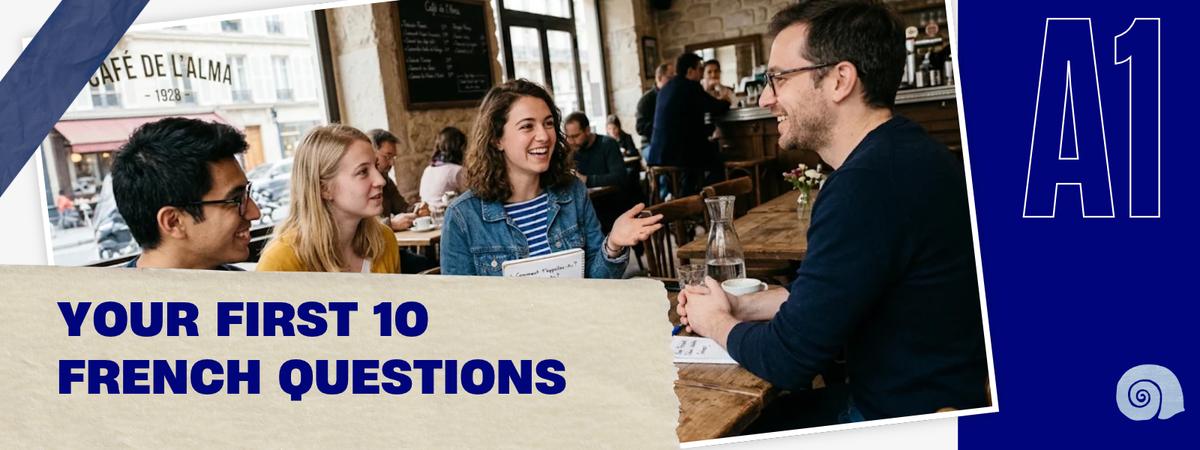
Have you ever wanted to ask someone a simple question in French but did not know how to start? Maybe you want to know someone's name, ask where the station is or find out what time it is. You know a few French words, but putting them together into a question feels much harder.
Here is the good news: you do not need to master French grammar before you can start asking questions. At the A1 level, a handful of useful expressions can help you in many everyday situations. Let's learn 10 essential French questions, see how they work and practise using them in short conversations.
A quick note on the pronunciation hints: ew means the French u. Say ee with rounded lips.
Pronunciation: koh-mahn tew tah-pell
This is a common way to ask someone's name in an informal situation. You might use it when meeting a new friend, talking to another student in a language class or introducing yourself to someone your age.
Example:
— Bonjour ! Comment tu t'appelles ?
— Je m'appelle Emma.
— Hello! What's your name?
— My name is Emma.
Your turn: say the question aloud, then answer it with your own name.
Useful tip: in a more formal situation, you can ask Comment vous appelez-vous ? For now, start with the informal version.
Pronunciation: tew ah-beet oo
This question is useful when getting to know someone. You can answer with a simple sentence: J'habite à Paris. — I live in Paris. If you live in another city, replace Paris with your city.
Example:
— Tu habites où ?
— J'habite à Lyon. Et toi ?
— Where do you live?
— I live in Lyon. And you?
Small grammar note: use à before most city names when saying where you live: à Paris, à Lyon, à Marseille.
Pronunciation: tew parl ahn-gleh
This question is helpful when travelling or meeting someone who might speak another language. In everyday French, you can often make a yes-or-no question simply by raising your voice at the end.
Compare:
The words stay the same. Your voice rises at the end when you ask the question.
Possible answers:
Try saying the question aloud with a rising voice.
Pronunciation: kel ahzh ah-tew
In French, people express their age with the verb avoir (to have), not être (to be). For example: J'ai 25 ans. — I'm 25 years old. Literally, this is closer to “I have 25 years.”
Mini-dialogue:
— Quel âge as-tu ?
— J'ai 22 ans. Et toi ?
One short email a week. No spam, unsubscribe anytime.
— How old are you?
— I'm 22. And you?
Remember: say J'ai 22 ans, not Je suis 22 ans. This is a common mistake for beginners who translate directly from English.
Pronunciation: kess-kuh tew em
Want to find something to talk about with a new French-speaking friend? Ask about their interests. You can talk about music, food, films, sports and hobbies.
Example:
— Qu'est-ce que tu aimes ?
— J'aime la musique et les films.
— What do you like?
— I like music and films.
You can also make the question more specific:
Your turn: ask yourself, Qu'est-ce que j'aime ? Then answer with one thing you enjoy.
Pronunciation: kess-kuh say
Use this question when you point at something you do not know: a dish, an object, a word on a sign. It is one of the best questions for a beginner, because it lets you learn new words from the people around you.
Mini-dialogue:
— Qu'est-ce que c'est ?
— C'est un croissant.
— What is this?
— It's a croissant.
Useful tip: c'est means “it is” or “this is”. You will hear it all the time, so learn it early.
Pronunciation: kel uhr eh-teel
This is a polite, standard way to ask the time. You can answer with:
Mini-dialogue:
— Excusez-moi, quelle heure est-il ?
— Il est trois heures.
— Merci !
— Excuse me, what time is it?
— It's three o'clock.
— Thank you!
Pronunciation: oo eh lah gahr
This is the question for finding your way. You can replace la gare with any place: la boulangerie (the bakery), l'hôtel (the hotel), la banque (the bank).
You may hear these answers:
Good to know: use Où est for one thing (Où est la gare ?) and Où sont for several (Où sont les toilettes ?).
Pronunciation: koh-mahn dee-tohn … ahn frahn-seh
This question is a real shortcut for learners. Whenever you do not know a word, put it in English into the gap and ask.
Example:
— Comment dit-on “thank you” en français ?
— On dit “merci”.
— How do you say “thank you” in French?
— You say “merci”.
One question like this can teach you more words than a whole page in a textbook.
Pronunciation: poor-kwah
Sometimes one word is enough to ask a question. Pourquoi ? helps you ask for a reason or understand something better.
Example:
— Pourquoi tu apprends le français ?
— Parce que j'aime la langue française.
— Why are you learning French?
— Because I like the French language.
Two useful words to remember: Pourquoi ? — Why? and Parce que… — Because… Learn them together and practise with your own reasons.
You do not need to memorise all 10 questions in one day. The goal is to remember them well enough to use them without constantly checking a translation.
Day 1: questions 1–3. Practise asking someone's name, where they live and which languages they speak. Answer each question aloud.
Day 2: review, then questions 4–6. Practise asking about age, interests and what something is. Answer each question with information about yourself.
Day 3: questions 7–10. Imagine you are travelling or talking to a French-speaking friend. Choose the question that fits each situation.
Day 4: create your own mini-dialogue. Combine at least four questions and their answers. Use your notes at first, then try again without looking.
Day 5: test your memory. Read the English translation and try to remember the French question. Check your answer only after you have tried.
Five to ten minutes of focused practice is a good start. Repeat the routine as needed rather than rushing through all the material.
Complete the sentences below.
Answers:
If you made a mistake, that is fine. Try the exercise once more before moving on.
Learning French does not have to begin with long grammar explanations or pages of vocabulary. Start with questions that help you interact with people. Ask their names, learn about their interests, find your way around and ask for the words you are missing.
These 10 questions give you a starting point for simple A1 conversations. Practise them aloud, use them in imaginary situations and return to them until they feel familiar.
Books, series breakdowns, and memes for language learners. Materials are shared with permission or link to authorised sources.
Learn 50 useful Spanish phrases for greetings, questions, shopping, eating out, and daily conversations, with English translations.
Learn useful Spanish phrases for ordering food, asking about ingredients, and paying the bill, with real-life restaurant dialogues.
Learn 40 essential Spanish words and phrases for the supermarket, with English meanings, shopping expressions, and a simple dialogue.
One short email with fresh words, phrases and free PDFs. No spam, unsubscribe anytime.