 LexioLearn
50 Spanish Phrases You’ll Actually Use Every Day
Learn 50 useful Spanish phrases for greetings, questions, shopping, eating out, and daily conversations, with English translations.
Learn 10 simple German questions with English translations and pronunciation hints. Start conversations and practise everyday German.
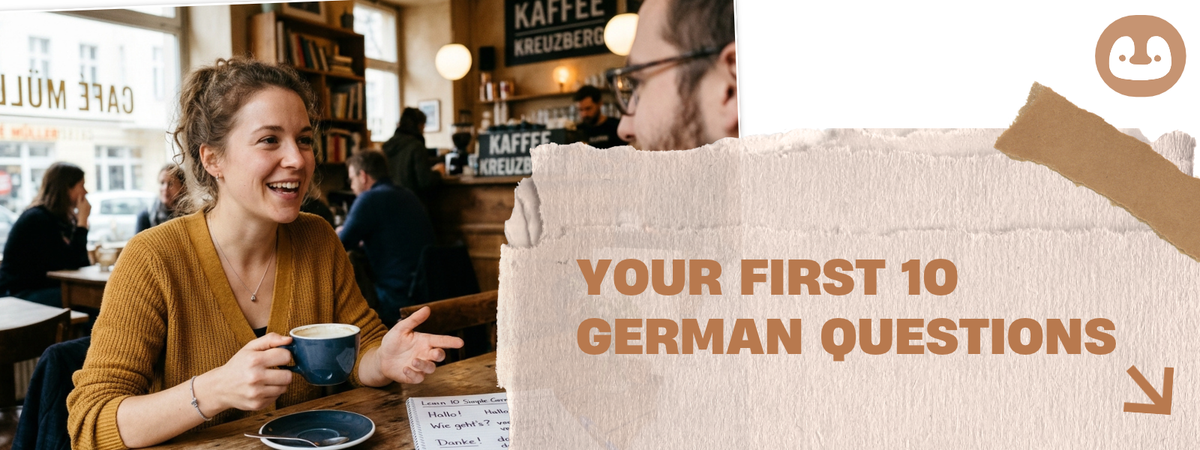
Want to start a conversation in German? Learn how to ask simple questions.
These 10 beginner-friendly German questions will help you get to know someone, ask for help, and communicate in everyday situations. Each question includes an English translation, a simple pronunciation guide, and a possible answer.
There are two simple patterns. With a question word (wie, wo, woher, was, welche), the order is: question word + verb + subject. For example: Wo wohnst du? For yes-or-no questions, the verb comes first: Sprichst du Deutsch? These two patterns will help you build many simple questions.
Pronunciation: vee hysst doo
Answer: Ich heiße Anna. — My name is Anna.
Du is the informal “you,” used with friends, family, and people you know well.
Pronunciation: voh-HAIR komst doo
Answer: Ich komme aus Spanien. — I come from Spain.
Don’t mix up Wo? (where) and Woher? (where from). Woher asks about someone’s origin.
Pronunciation: voh vohnst doo
Answer: Ich wohne in London. — I live in London.
This is a different question from the previous one, because someone can come from one country and live in another.
Pronunciation: vee gayt es deer
Answers: Mir geht es gut. — I’m doing well. Nicht schlecht. — Not bad.
In everyday speech you will often hear the short form Wie geht’s?
Pronunciation: VEL-khuh SHPRAH-khen shprikhst doo
Answer: Ich spreche Englisch und ein bisschen Deutsch. — I speak English and a little German.
Sprachen is the plural of Sprache (language).
Pronunciation: vahs makhst doo buh-ROOF-likh
Answers: Ich bin Studentin. — I’m a student. Ich arbeite in einem Büro. — I work in an office.
Pronunciation: vahs makhst doo gairn
Answers: Ich lese gern. — I like reading. Ich koche gern. — I like cooking.
The little word gern shows that you enjoy doing something.
Pronunciation: hahst doo guh-SHVIS-ter
Answers: Ja, ich habe einen Bruder. — Yes, I have a brother. Nein, ich bin Einzelkind. — No, I’m an only child.
Geschwister is normally used in the plural.
Pronunciation: kahnst doo meer HEL-fen
Answers: Ja, natürlich! — Yes, of course! Ja, gern. — Yes, gladly.
When you use können (can), the second verb goes to the end in its basic form: Kannst du mir helfen?
Pronunciation: kahnst doo dahs BIT-uh vee-der-HOH-len
One of the most useful questions for beginners. You can also say Wie bitte? (Pardon?) or Kannst du langsamer sprechen? (Can you speak more slowly?)
German has two ways to say “you.” Du is informal (friends, family, people you know well), and Sie is formal (strangers, shops, work). The verb changes too: Wie heißt du? becomes Wie heißen Sie?, and Kannst du mir helfen? becomes Können Sie mir helfen? If you’re unsure, Sie is the safer choice.
You now know 10 useful questions for everyday conversations. You don’t need to memorise every grammar rule before using them. Start by recognising these expressions and noticing how German speakers use them.
In Austria, I wish I had known one more question: Wie sagt man “fine” auf Deutsch? — How do you say “fine” in German? It would have saved me an evening of guessing between three languages. Whenever you get stuck on a word, this question is your best friend.
Books, series breakdowns, and memes for language learners. Materials are shared with permission or link to authorised sources.
Learn 50 useful Spanish phrases for greetings, questions, shopping, eating out, and daily conversations, with English translations.
Learn useful Spanish phrases for ordering food, asking about ingredients, and paying the bill, with real-life restaurant dialogues.

Learn 40 essential Spanish words and phrases for the supermarket, with English meanings, shopping expressions, and a simple dialogue.
One short email with fresh words, phrases and free PDFs. No spam, unsubscribe anytime.