 LexioLearn

50 Spanish Phrases You’ll Actually Use Every Day
Learn 50 useful Spanish phrases for greetings, questions, shopping, eating out, and daily conversations, with English translations.
Learn 10 simple German sentences with English meanings and pronunciation hints. A beginner-friendly A1 guide for everyday situations.
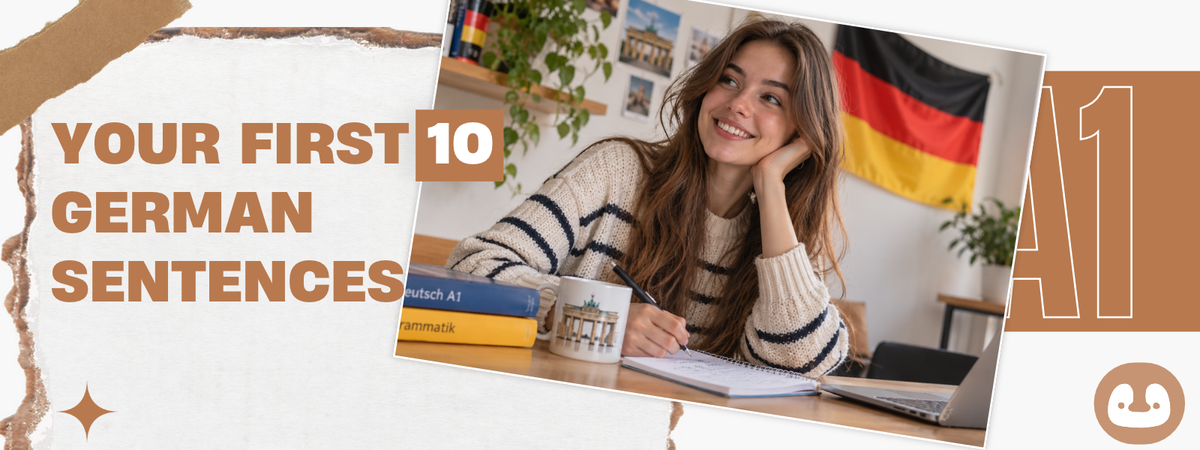
Learning German starts with simple sentences you can use in everyday life. You don’t need complicated grammar or hundreds of words to begin communicating.
In this beginner-friendly A1 guide, you’ll learn 10 useful German sentences, their English meanings, and simple pronunciation hints.
Pronunciation: HAH-loh
A friendly, informal greeting for friends, classmates, and people you meet in everyday situations. For a slightly more formal greeting, use Guten Tag! (Good day!), Guten Morgen! (Good morning!), or Guten Abend! (Good evening!).
Pronunciation: ikh HIGH-suh AH-nah
Use this sentence to introduce yourself. The verb heißen means “to be called.” You can also say Ich bin Anna. — I am Anna.
Pronunciation: ikh KOH-muh ows ENG-lant
Use the pattern Ich komme aus + place. For example: Ich komme aus Deutschland (Germany), Ich komme aus Spanien (Spain), or Ich komme aus den USA (the USA). Some country names need an article, like den USA, but most don’t.
Pronunciation: ikh VOH-nuh in bair-LEEN
The verb wohnen means “to live.” Note the difference: Ich komme aus Berlin means you are from Berlin, while Ich wohne in Berlin means you live there now.
Pronunciation: ikh bin shtoo-DEN-tin
Many German job words have a masculine and a feminine form. A male student is Student, a female student is Studentin. The same works for Lehrer / Lehrerin (teacher) and Arzt / Ärztin (doctor).
Pronunciation: ikh SHPREH-khuh ENG-lish
Use it to say which languages you speak. You can add ein bisschen (a little): Ich spreche ein bisschen Deutsch. — I speak a little German.
Pronunciation: ikh LAIR-nuh doytsh
A great sentence for beginners. Notice that German language names start with a capital letter: Deutsch, Englisch, Spanisch.
Pronunciation: ikh fair-SHTAY-uh dahs nikht
You will probably use this one often, and that’s completely normal. Nicht makes the sentence negative. To say you do understand, just drop it: Ich verstehe.
Pronunciation: ikh HAH-buh EYE-nuh FRAH-guh
Use it when you need help or want to ask something. Frage is a feminine noun (die Frage), which is why it comes with eine.
Pronunciation: DAHN-kuh fuer DYE-nuh HIL-fuh
(The sound “ue” is like the French “u”: round your lips and say “ee”.) For something shorter, use Danke! or Vielen Dank! (Thank you very much!). With someone you don’t know well, say Danke für Ihre Hilfe.
You don’t need to speak perfectly from day one. Start with a few useful expressions, learn when to use them, and gradually build your confidence.
I learned this the funny way. I spent my birthday in Austria with A1 German, in a not-so-great mood and with a drink or two in me. I ordered meat in three languages and came very close to pointing at the menu with my fingers. Then I got a parking fine, and that was the real stress. I had no idea whether it could cause problems when leaving the country, or whether the amount would be tripled. I tried to find the right word for “fine” in English, German, and French, but nothing worked. The two variants I knew only translated as “bill”, and the waiters didn’t recognise any version of “fine”. For them it was simply a “ticket”. Later I learned the words I really needed: Strafzettel (a parking ticket, literally a “penalty slip”) and Bußgeld (a fine). In the end, the poor waiter felt sorry for me and treated me to a drink for my efforts.
A few simple sentences would have saved me a lot of stress, and they might do the same for you.
Books, series breakdowns, and memes for language learners. Materials are shared with permission or link to authorised sources.
Learn 50 useful Spanish phrases for greetings, questions, shopping, eating out, and daily conversations, with English translations.
Learn useful Spanish phrases for ordering food, asking about ingredients, and paying the bill, with real-life restaurant dialogues.
Learn 40 essential Spanish words and phrases for the supermarket, with English meanings, shopping expressions, and a simple dialogue.
One short email with fresh words, phrases and free PDFs. No spam, unsubscribe anytime.