 LexioLearn

50 Spanish Phrases You’ll Actually Use Every Day
Learn 50 useful Spanish phrases for greetings, questions, shopping, eating out, and daily conversations, with English translations.
Learn 10 simple Spanish sentences with English meanings and pronunciation hints. A beginner-friendly A1 guide for everyday situations.

Learning Spanish starts with simple sentences you can use in everyday life. You don’t need complicated grammar or hundreds of words to begin communicating.
In this beginner-friendly A1 guide, you’ll learn 10 useful Spanish sentences, their English meanings, and simple pronunciation hints.
Pronunciation: OH-lah
A friendly greeting for friends, classmates, and people you meet in everyday situations. The letter h is silent in Spanish. For a slightly more formal greeting, use Buenos días (Good morning), Buenas tardes (Good afternoon), or Buenas noches (Good evening / Good night).
Pronunciation: meh YAH-moh AH-nah
Use this sentence to introduce yourself. Literally, it means “I call myself Anna.” You can also say Soy Anna. — I am Anna.
Pronunciation: soy deh een-glah-TEH-rrah
Use the pattern Soy de + place. For example: Soy de España (Spain), Soy de Alemania (Germany), or Soy de Estados Unidos (the USA). Most country names don’t need an article in this sentence.
Pronunciation: VEE-voh en mah-DREED
The verb vivir means “to live.” Note the difference: Soy de Madrid means you are from Madrid, while Vivo en Madrid means you live there now. In Spanish, the letter v sounds very close to b, so vivo sounds almost like “bee-boh.”
Pronunciation: soy ehs-too-DYAN-teh
The word estudiante is the same for a man and a woman. Many other job words change: profesor / profesora (teacher), médico / médica (doctor). Notice that Spanish doesn’t use “a” before a job: you say Soy estudiante, not “Soy un estudiante.”
Pronunciation: AH-bloh een-GLEHS
Use it to say which languages you speak. You can add un poco de (a little): Hablo un poco de español. — I speak a little Spanish. Notice that Spanish language names don’t start with a capital letter: inglés, español, francés.
Pronunciation: ehs-TOY ah-pren-DYEN-doh ehs-pah-NYOHL
A great sentence for beginners. The letter ñ sounds like “ny” in the English word “canyon.” You can also use the shorter Aprendo español. — I learn Spanish.
Pronunciation: noh en-TYEN-doh
You will probably use this one often, and that’s completely normal. The word no makes the sentence negative. To say you do understand, just drop it: Entiendo.
Pronunciation: TEN-goh OO-nah preh-GOON-tah
Use it when you need help or want to ask something. Pregunta is a feminine noun (la pregunta), which is why it comes with una. A masculine noun would use un: un libro (a book).
Pronunciation: GRAH-syahs por too ah-YOO-dah
In most of Spain, gracias sounds more like GRAH-thyahs. Both versions are understood everywhere. For something shorter, use ¡Gracias! or ¡Muchas gracias! (Thank you very much!). With someone you don’t know well, say Gracias por su ayuda.
You don’t need to speak perfectly from day one. Start with a few useful expressions, learn when to use them, and gradually build your confidence.
Books, series breakdowns, and memes for language learners. Materials are shared with permission or link to authorised sources.
Learn 50 useful Spanish phrases for greetings, questions, shopping, eating out, and daily conversations, with English translations.
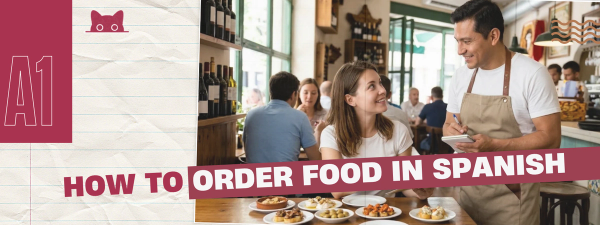
Learn useful Spanish phrases for ordering food, asking about ingredients, and paying the bill, with real-life restaurant dialogues.

Learn 40 essential Spanish words and phrases for the supermarket, with English meanings, shopping expressions, and a simple dialogue.
One short email with fresh words, phrases and free PDFs. No spam, unsubscribe anytime.